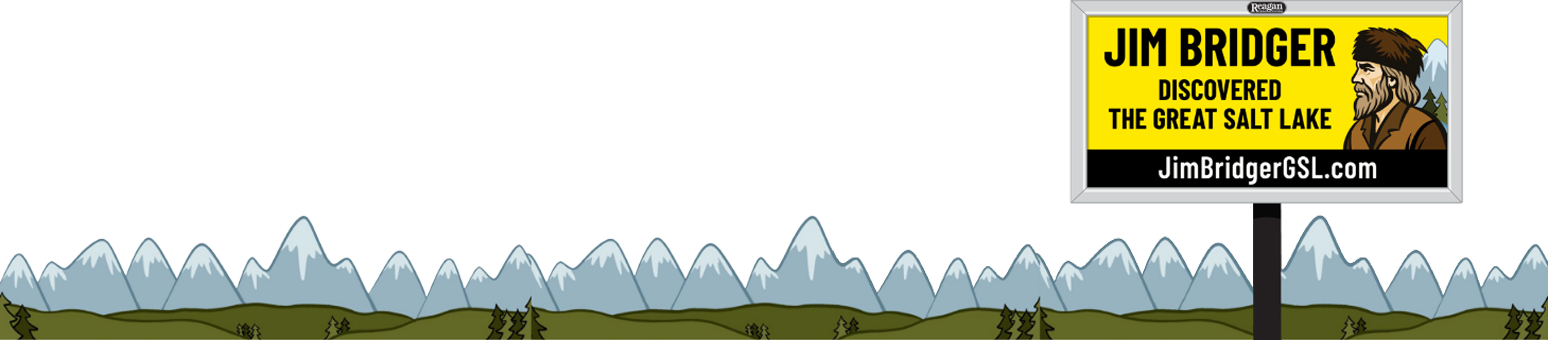
“WE’RE ON THE SHORES OF THE PACIFIC!”
The Great Salt Lake: Discovery and Early Exploration
While multiple explorers traveled through the region during the early 19th century, Bridger’s accounts remain the most widely documented. This summary combines historical records, Indigenous histories, and contemporary research to provide a balanced view of the discovery and exploration of the Great Salt Lake region.
Indigenous Presence
For thousands of years before European and American explorers arrived, the Great Salt Lake region was home to Indigenous peoples, including the Timpanogos, Shoshone, and Goshute. These communities lived along the valleys, rivers, and wetlands, relying on fishing, hunting, and gathering for survival. Their knowledge of the land and its resources was extensive, and the Great Salt Lake and surrounding lands were well-known long before non-Native explorers arrived.
Jim Bridger: Explorer and Mountain Man
James “Jim” Bridger (1804–1881) was one of the most prominent mountain men, scouts, and explorers of the American West. Born in Richmond, Virginia, Bridger came from a family of English ancestry with deep roots in early colonial America.
In 1824, at age twenty, Bridger joined a fur-trapping expedition traveling through present-day Utah. When the party debated where the Bear River emptied, Bridger decided to investigate. He constructed a small buffalo-skin boat, often called a “bullboat,” and navigated the river to its end. The river eventually led him into a vast inland lake. According to accounts, Bridger bent down to drink and discovered the water was salty, mistakenly thinking he had reached the Pacific Ocean.
Bridger had in fact discovered what is now known as the Great Salt Lake. His journey down the Bear River in 1824 is the earliest well-documented account of a non-indigenous reaching the lake, though other explorers may have arrived around the same time.
Historical Controversy
While Bridger is commonly credited as the documented discoverer of the Great Salt Lake, historical debate exists. French trapper Étienne Provost traveled into Utah in 1824 from Santa Fe under a Mexican license and may have entered the Salt Lake Valley that same year.
Provost’s party was attacked by a band of Snake indigenous, leaving him and a few survivors to flee east to the Green River, where they spent the winter near the mouth of the White River. The exact location of the attack remains uncertain. If it occurred along the Jordan or Weber rivers, Provost may have reached the lake before Bridger. If it occurred along the Provo River, he would have been about forty miles south of the lake.
Because evidence is limited, historians cannot definitively say who was first. Nevertheless, Bridger’s 1824 journey remains the earliest well-documented account, earning him recognition as the documented discoverer of the Great Salt Lake by American explorers.
For more information, see the Historical Controversy